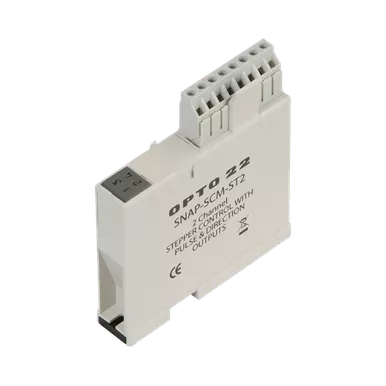
OPTO 22 – SNAP-SCM-ST2 _ Pulse & Direction Digital Outputs X2
OPTO 22 – SNAP-SCM-ST2 _ Pulse & Direction Digital Outputs X2
Quick Specs:
- Pulse & Direction Digital Outputs X2
The SNAP-SCM-ST2 pulse output module is a two-channel serial communication module that provides pulse and direction signals for stepper motor drives. Each channel is isolated from the logic side. The module can either output a constant frequency, or it can ramp from one frequency to another.
The SNAP-SCM-ST2 links up to two stepper motors which can then be controlled by a SNAP PAC controller running a PAC Control¢ programming strategy. LED indicators are provided to indicate activity on each port.
The module snaps onto an Opto 22 SNAP PAC mounting rack. SNAP PAC racks accommodate up to 4, 8, 12, or 16 I/O modules, with a maximum of 8 serial modules (including SNAP-SCM-ST2) on any one rack. Because the SNAP-SCM-ST2 module is mounted on these standard racks with other SNAP I/O modules, you can use the combination of analog, digital, and serial modules required by your application at the location where they are needed.
Specifications:
|
Frequency Range |
0.13 – 50,000 Hz |
|
Pulse Width Range1 |
3.84 Sec to 10 µSec |
|
Pulse Width Accuracy2 |
0 – 2 Hz, 2 – 30 Hz, 30 – 50,000 Hz |
|
Output Format |
CMOS/TTL Compatible |
|
Logic Supply Voltage |
5.0 VDC |
|
Logic Supply Current |
200 mA |
|
Compatible I/O Processors |
SNAP PAC R-series controllers and EB-series brains with R9.1a or newer firmware |
|
Duty Cycle |
Fixed at 50% |
|
Number of Ports per Module |
2 |
|
Operating Temperature Range |
-20 – 60 °C |
|
Storage Temperature Range |
-30 – 85 °C |
|
Warranty |
30 months from date of manufacture |
|
1Pulse Width is equal to one-half the period. 2To find the frequency error in Hz: |